
The Rules That Save Lives
Every year, thousands of preventable tragedies happen because someone treated a firearm like a toy, skipped a rule “just this once,” or assumed “it can’t happen to me.” Whether you own one gun or a hundred, whether you hunt, compete, carry for self-defense, or simply keep one for home protection, the foundation of responsible gun ownership is the same: an uncompromising commitment to safety.
Here are the core principles that every firearm owner, new or experienced, must internalize and practice every single time.
The Four Universal Safety Rules
These rules, originally formulated by Colonel Jeff Cooper at Gunsite, are non-negotiable. If you follow all four, all the time, it is practically impossible to have an unintentional discharge that hurts someone.
- Treat every firearm as if it is loaded.
No exceptions. Even if you just cleared it yourself. Even if someone “reliable” handed it to you unloaded. Check it yourself, and still handle it as though it’s ready to fire. - Never point the muzzle at anything you are not willing to destroy.
Keep it pointed in a safe direction at all times—downrange, at the ground, or into a bullet trap if you’re at home. “Safe direction” means even if the gun fired right now, no one would be hurt and property damage would be minimal. - Keep your finger off the trigger until your sights are on the target and you’ve made the decision to shoot.
The trigger finger should be straight and outside the trigger guard (“high register” on the frame). Most negligent discharges happen because a finger was on the trigger when someone stumbled, got startled, or tried to catch a falling gun. - Be sure of your target and what is beyond it.
Bullets punch through walls, car doors, and sometimes even the target itself. Know what’s behind and beside your target—in a home-defense scenario that might be your kids’ bedroom.
Additional Lifesaving Habits
Beyond the four rules, these practices separate responsible owners from statistics:
- Administrative handling only in a designated safe area.
Cleaning, dry-fire practice, showing off a new gun—do it where the muzzle can’t sweep anything living. - Use quality holsters that fully cover the trigger guard.
A Serpa holster with a finger button or a flimsy nylon “one-size-fits-all” can turn a re-holster into a tragedy. - Store firearms securely when not in use.
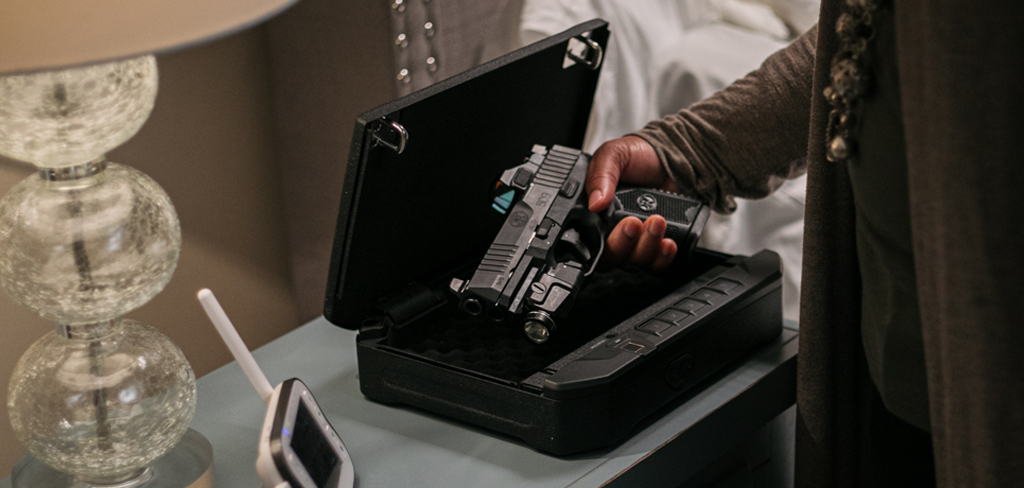
A loaded gun in a nightstand drawer is fast, but not if a child or burglar gets to it first. Quick-access safes (e.g., Vaultek, Fort Knox, or even a simple Simplex-lock box) give you both speed and security. - Ammunition and firearms are separate when children are present and you’re not carrying.
Even if you think your kid “knows better,” the data show curious teens and visiting friends are at highest risk. - Never mix alcohol or impairing drugs with firearms.
More than half of all fatal firearm accidents involve alcohol. - Get real training and practice regularly.
A four-hour concealed-carry class is a start, not mastery. Force-on-force, low-light shooting, and one-handed malfunction drills reveal how fast things go wrong when adrenaline hits.
Common Myths That Get People Hurt
- “Glocks/revolvers/1911s are ‘drop-safe’ so I can toss it on the bed.”
Modern firearms are remarkably safe—until something gets into the trigger guard while the gun is moving. - “It’s just a .22, it’s not dangerous.”
Tell that to the families of children killed every year by “harmless” .22s.
Teaching the Next Generation
Start early, but never rely on “I taught them” as a substitute for secure storage. The Eddie Eagle program (“Stop, don’t touch, run away, tell an adult”) works for very young kids. Once they’re old enough, demystify firearms: take them shooting under strict supervision. A child who has fired a .22 under your guidance is far less likely to play with one they find at a friend’s house.
Final Thought
Firearms are tools—extraordinarily effective, unforgiving tools. Respect them the way a chainsaw or a circular saw deserves respect: with training, sober attention, and layers of safety. The gun community doesn’t need fewer guns; it needs more people who treat every single gun as a loaded gun, every single time.
Stay safe, train hard, and never get complacent.
— A fellow shooter who wants you to make it home to your family tonight.